Last updated: 7 April 2026
Parsley (Petroselinum crispum) is one of the most useful herbs you can grow in a UK garden. It works in almost every savoury dish, it grows happily in pots on a windowsill or patio, and once established, it keeps producing fresh leaves for months. Whether you have a sprawling veg patch or a single container by the back door, parsley is a superb choice for beginners.
Below, you will find everything you need to grow parsley successfully in the UK — from choosing the right variety and sowing your first seeds through to harvesting, troubleshooting problems, and keeping plants going over winter. If you are already growing other herbs, this guide pairs well with our articles on growing basil, mint, and rosemary.
Why Grow Parsley?
Parsley earns its place in any herb collection for several reasons:
- Versatile in the kitchen. Flat-leaf parsley delivers bold flavour to tabbouleh, chimichurri, soups, and stews. Curly parsley works as a garnish, in sauces, and in classic parsley sauce for fish or ham.
- Nutritionally dense. Parsley is rich in vitamins C, K, and A, plus iron and folate — far more than a decorative garnish.
- Pollinator-friendly. If you let a second-year plant flower, its umbels attract hoverflies, bees, and beneficial wasps to your garden.
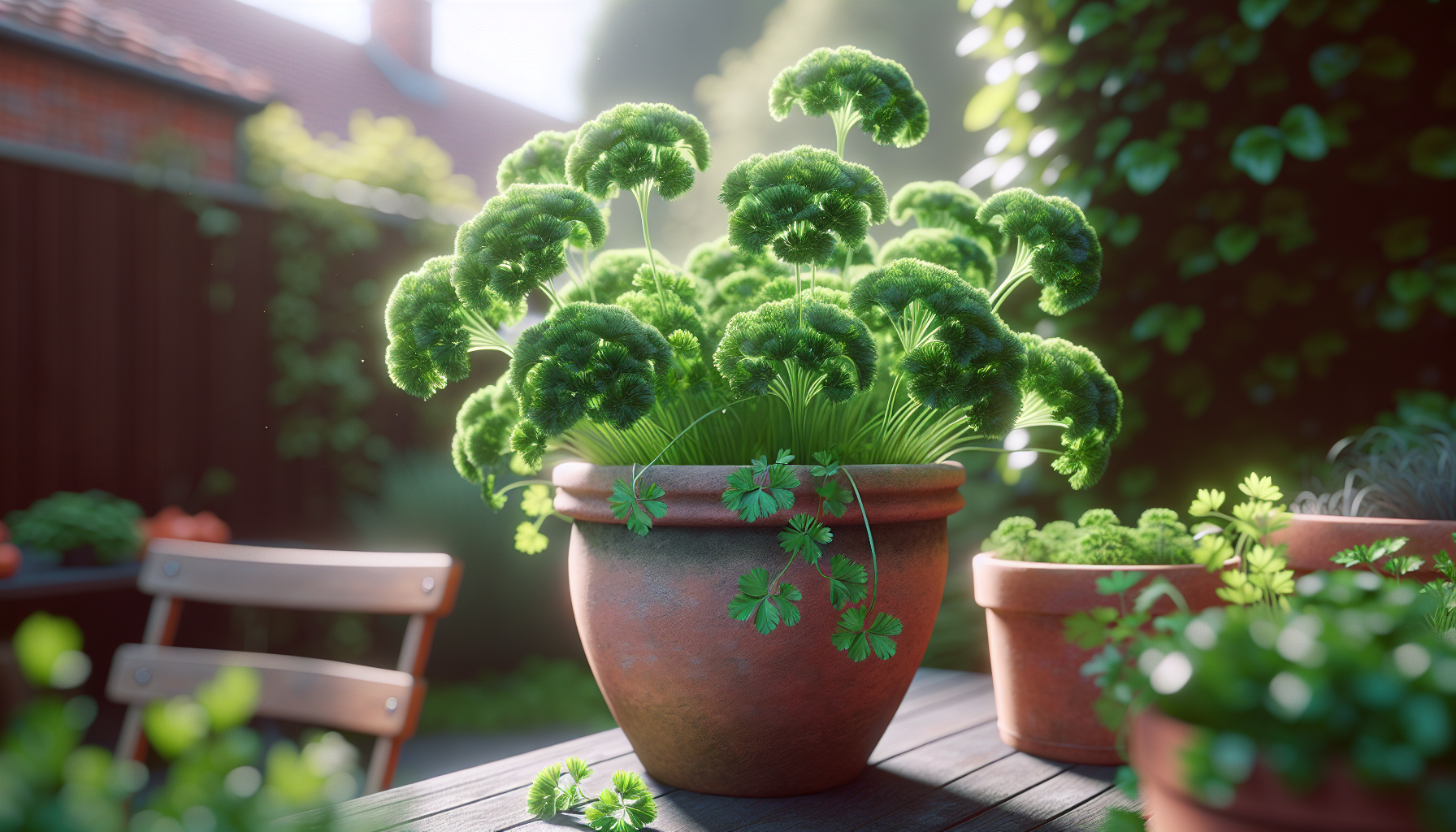
- Easy to grow in containers. Parsley has a compact root system that makes it ideal for pots, window boxes, and raised beds — perfect if space is limited. See our guide to the best containers for beginners for pot recommendations.
- Long harvest season. With successional sowing, you can harvest fresh parsley from late spring through to early winter.
Best Parsley Varieties for UK Gardens
There are two main types of parsley, and several named cultivars worth seeking out.
Flat-Leaf (Italian) Parsley
Flat-leaf parsley (Petroselinum crispum var. neapolitanum) has smooth, deeply divided leaves and a stronger, more rounded flavour than curly types. It is the preferred choice for cooking. Popular cultivars include ‘Giant of Italy’ and ‘Gigante di Napoli’, both vigorous growers that reach 45–60 cm tall.
Curly-Leaf Parsley
Curly parsley has densely crimped leaves and a milder, slightly peppery taste. It holds up well as a garnish and adds texture to salads. Several curly cultivars have earned the AGM from the Royal Horticultural Society, recognising reliable performance in UK growing conditions:
| Cultivar | RHS AGM | RHS Hardiness | Notes |
|---|---|---|---|
| ‘Bravour’ | Yes | H6 (hardy to −20 °C) | Exceptionally hardy, vigorous growth, dark green leaves |
| ‘Curlina’ | Yes | H4 (hardy to −10 °C) | Compact habit, densely curled leaves — ideal for containers |
| ‘Envy’ | Yes | H4 (hardy to −10 °C) | Tightly curled, uniform plants, good disease resistance |
| ‘Moss Curled’ | Yes | H6 (hardy to −20 °C) | Classic variety, widely available from UK seed suppliers |
For beginners, ‘Moss Curled’ is widely stocked by UK seed suppliers (Thompson & Morgan, Suttons, Mr Fothergill’s) and performs reliably across the country. For cooking, a flat-leaf variety like ‘Giant of Italy’ gives the strongest flavour.
Choosing Containers and Compost
Parsley grows extremely well in containers. Here is what you need:
- Pot size: A minimum depth of 20 cm. Parsley has a long taproot, so deeper pots (25–30 cm) produce healthier plants. A single plant does fine in a 15 cm pot; for a continuous supply, use a 30–40 cm trough and sow several plants.
- Drainage: Essential. Choose pots with drainage holes and add a 2 cm layer of crocks or gravel at the base.
- Compost: Use a good-quality peat-free multipurpose compost. Parsley prefers a slightly rich, moisture-retentive mix. Mixing in a handful of perlite improves drainage without sacrificing moisture. Read our guide to the best compost for containers for detailed recommendations.
Parsley also grows well in the ground, in borders, raised beds, or alongside vegetables. It tolerates partial shade — in fact, a spot that gets morning sun and afternoon shade suits it perfectly during hot summers.
Sowing Parsley from Seed
Parsley has a reputation for slow, erratic germination — but a few simple techniques dramatically improve results.
When to Sow
| Method | Timing | Temperature |
|---|---|---|
| Indoors (seed trays/modules) | February – March | 18–21 °C |
| Direct sow outdoors | April – June | Soil above 10 °C |
| Successional sowing (for continuous harvest) | Every 4–6 weeks, April – July | — |
Step-by-Step Sowing Guide
- Soak the seeds. Place parsley seeds in a bowl of warm water (not boiling) and leave them to soak for 12–24 hours. This softens the hard seed coat and can cut germination time in half.
- Fill modules or small pots with moist peat-free compost. Firm gently.
- Sow 2–3 seeds per module, pressing them lightly into the surface. Cover with a thin layer of vermiculite or sieved compost — no deeper than 5 mm. Parsley needs some light to germinate.
- Water with a fine rose to avoid disturbing the seeds.
- Cover with a clear lid or cling film to retain humidity. Place on a warm windowsill or in a propagator at 18–21 °C.
- Be patient. Germination takes 14–28 days. Keep the compost consistently moist but not waterlogged.
- Thin to one seedling per module once the first true leaves appear. Snip the weaker seedlings at soil level rather than pulling them out.
- Harden off and plant out once seedlings have 3–4 true leaves and all risk of hard frost has passed (typically mid-April to May, depending on your region). Space plants 15–20 cm apart.
Ongoing Care: Watering, Feeding, and Pruning
Watering
Parsley likes consistently moist soil. In containers, check daily during warm weather — the compost should feel damp 2 cm below the surface. Water at the base of the plant, not over the leaves, to reduce the risk of fungal diseases. Mulching around outdoor plants with garden compost helps retain moisture.
Feeding
Parsley is a moderately hungry herb. Feed container-grown plants every 2–3 weeks with a balanced liquid feed (such as seaweed extract) from June onwards. Plants in rich garden soil rarely need additional feeding in their first year.
Pruning and Maintenance
Regular harvesting is the best form of pruning. If you notice flower stems forming in the second year (parsley is a biennial), pinch them out promptly to prolong leaf production. Once a plant is fully bolting, the leaves turn bitter — at that point, let it flower for the pollinators and sow fresh seed for next year.
Remove any yellowing or damaged leaves from the base of the plant to improve air circulation and reduce the risk of disease.
How to Harvest Parsley
Start harvesting once plants have at least 8–10 stems. The key technique is to cut whole stems from the outside of the plant, working inwards. This encourages new growth from the centre.
- Use sharp scissors or secateurs to cut stems at the base, close to soil level.
- Never strip all the leaves from a single plant — always leave at least a third of the foliage so the plant can recover.
- Harvest regularly, even if you do not need the parsley immediately. This keeps the plant productive and prevents it from becoming leggy.
- Parsley is best used fresh, but it freezes well. Chop leaves finely, pack into ice-cube trays, top up with water, and freeze. Drop frozen cubes directly into soups, stews, and sauces.
Common Problems and How to Fix Them
Slow or No Germination
The most common issue. Parsley seeds have a hard coat and contain germination inhibitors. Pre-soaking seeds for 12–24 hours, maintaining warmth (18–21 °C), and keeping the compost consistently moist will solve most germination failures. Use fresh seed — parsley seed viability drops sharply after one year.
Yellowing Leaves
Usually caused by overwatering, poor drainage, or nutrient deficiency. Check that pots drain freely. If the compost is waterlogged, repot into fresh compost with added perlite. A liquid seaweed feed often greens plants up within a fortnight.
Carrot Fly
Parsley belongs to the same family as carrots (Apiaceae) and is susceptible to carrot fly (Chamaepsila rosae). The larvae tunnel into roots, weakening the plant. Protect with fine mesh (Enviromesh) draped over plants, or grow in containers raised at least 60 cm off the ground — carrot fly is a low-flying insect and rarely reaches elevated pots.
Aphids
Greenfly occasionally colonise parsley stems, especially in warm, sheltered spots. Blast them off with a strong jet of water, or introduce ladybird larvae as a biological control. Avoid chemical pesticides on herbs you intend to eat.
Powdery Mildew
A white, powdery coating on leaves, most common in late summer when nights are cool and days are warm. Improve air circulation by spacing plants adequately, water at the base rather than overhead, and remove affected leaves promptly. Resistant cultivars like ‘Envy’ are less prone to mildew.
Bolting
As a biennial, parsley flowers in its second year and then dies. In hot summers, first-year plants may bolt prematurely if stressed by drought or heat. Keep soil consistently moist and provide afternoon shade during heatwaves. Once a plant bolts fully, the leaves become bitter — replace it with a fresh sowing.
Overwintering Parsley
Parsley is biennial, so first-year plants will survive most UK winters and produce a flush of leaves in early spring before flowering. Here is how to keep them going:
- Outdoor plants: Apply a thick mulch of straw or leaf mould around the base in late autumn. In colder regions (Scotland, northern England, exposed sites), cover with a cloche or fleece from November onwards.
- Container plants: Move pots to a sheltered spot against a south-facing wall, or bring them into an unheated greenhouse, porch, or cold frame. Hardy cultivars like ‘Bravour’ and ‘Moss Curled’ (both RHS H6) tolerate down to −20 °C, but waterlogged compost in freezing conditions will kill roots faster than the cold itself.
- Windowsill: A pot of parsley on a bright kitchen windowsill will produce leaves through winter, though growth slows considerably. Reduce watering and stop feeding until March.
For an unbroken supply of fresh leaves year-round, the simplest approach is to sow a fresh batch each spring and allow the previous year’s plants to flower and set seed.
Frequently Asked Questions
- How long does parsley take to germinate?
- Parsley typically takes 14–28 days to germinate, which is slower than most common herbs. Soaking seeds in warm water for 12–24 hours before sowing can reduce this to 10–14 days. Consistent warmth (18–21 °C) and moisture are essential — do not let the compost dry out during this period.
- Can I grow parsley indoors all year round?
- Yes, parsley grows well on a bright windowsill that receives at least 4–6 hours of light daily. Growth will slow in winter due to shorter days, but a south-facing window usually provides enough light. If your windowsill is dark, a small LED grow light makes a significant difference. Use a pot at least 20 cm deep and keep the compost evenly moist.
- Is flat-leaf or curly parsley better?
- Both are excellent — it depends on how you use them. Flat-leaf parsley has a stronger, more complex flavour and is the standard choice for cooking. Curly parsley has a milder taste and works beautifully as a garnish or in fresh salads. Many gardeners grow both. If you only have space for one, flat-leaf is the more versatile option in the kitchen.
- Why has my parsley turned yellow?
- The most likely causes are overwatering (check drainage), underwatering (check the compost is moist), or nutrient deficiency (apply a balanced liquid feed). Yellowing lower leaves on an otherwise healthy plant can simply mean the plant is redirecting energy to new growth — remove the yellow leaves and monitor.
- Can I save parsley seeds from my own plants?
- Absolutely. Allow second-year plants to flower and set seed. Once the seed heads turn brown and dry (usually late summer), cut them off and shake the seeds into a paper bag. Store in a cool, dry, dark place. Use within one year for best germination rates — parsley seed viability declines rapidly compared to other herbs.
What Next?
Once you have parsley established, you are well on your way to building a productive herb collection. Here are some logical next steps:
- Expand your herb garden. Parsley pairs well with basil, mint, and rosemary in the kitchen — and they are equally straightforward to grow. See our guides to growing basil, growing mint, and growing rosemary.
- Explore container growing. If you are growing parsley in pots, our roundup of the best herbs for containers covers what else thrives in confined spaces.
- Improve your plant care knowledge. Visit our plant care hub for general guidance on feeding, watering, pest control, and seasonal maintenance.
For authoritative advice on parsley cultivation, including pest and disease identification, the RHS parsley growing guide is an excellent reference.
Leave a Reply